
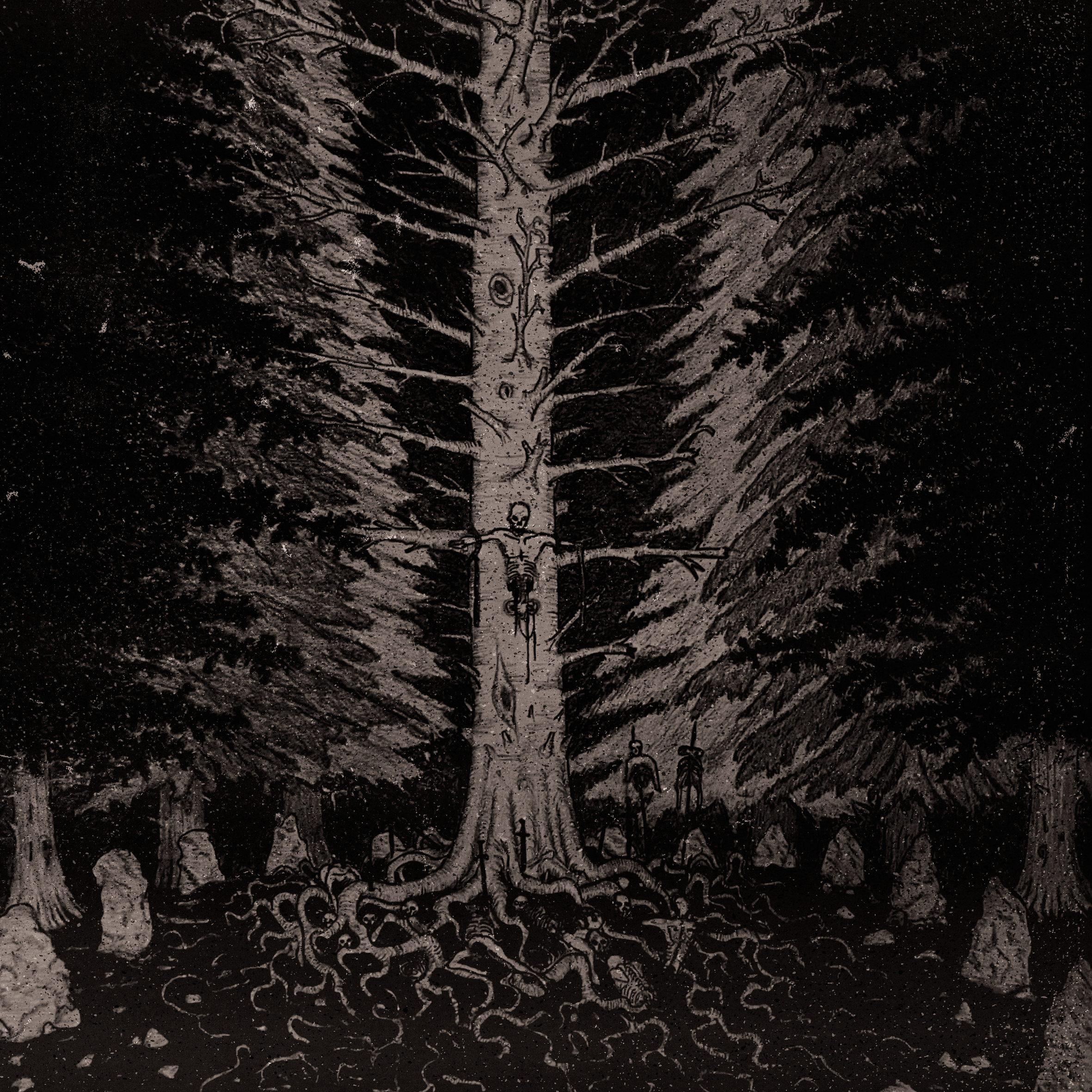

Despite all the black metal that I consume, the rawest edges of the genre are not something I’m too familiar with… there’s certainly an art form to trve kvlt production, but sometimes it can detract from the music itself. At the encouragement of our treasured editor Josh I was encouraged to check out the fourth full-length from Swiss solo act Aspaarn. This listen challenges my own tastes and sensibilities with its violently primitive presentation, yet the end result is thematically appropriate and quite unique to my black metal journey so far. Let’s take a trip back to the darkness of humanity’s early era and see what Oblations in Atrocity is all about.
It’s not uncommon for an album’s introduction — black metal or not — to open with some distant-sounding guitars and rawer or muffled production before diving in to what the rest of the album will sound like. After an ominous synth intro, the first overpowering drum hits and nauseatingly bleak guitars came in and it became apparent within the first couple of minutes of “The Order of Fear” that this would be the entire album. I was half-tempted to abandon the release right there, as it was difficult to parse what I was even listening to… but for sheer interest in the thematic purpose of such primitive production I decided to stick with it. Aspaarn is aesthetically focused around prehistoric Europe, in which a burgeoning human species faced off against both the violence of nature as well as other humans… with the added storytelling factor of long-forgotten deities acting as an extra barrier to humanity’s survival.
So how exactly does such a bleak and hostile world fit so well with Oblations in Atrocity? By sounding bleak and hostile, of course. In my experience raw black metal tends to be extremely fuzzy and trebly, with the drumming sometimes presenting itself as mere rhythmic noises in the background — almost unable to be heard. Aspaarn subverts this trope completely as the overall sound is cavernous and pretty heavy on the low end, with the drums being the loudest element of the entire sound (cymbal crashes especially almost overpower the rest of the instrumentation). But what makes the album fit so appropriately with the chosen themes is how distant the sound is; it might as well be recorded from a different room, or in this case the darkest depths of a Stone Age forest. The additional factor that makes Oblations so interesting — and probably why I didn’t stop after the first couple minutes of listening — is that all the instruments are quite present in the overall production. You just have to really dig in and retrain your ears to figure out what’s going on.

As far as the actual musical qualities of Oblations in Atrocity go, it’s second wave-inspired black metal like many others out there, with a heaping dose of dissonance thrown into its riffs to accentuate the despair of the setting. Blast beats are infrequent, with most of the album existing at mid-tempo. Once you’re able to parse the riffs being played, repeating motifs present themselves. It’s also hard not to think of caverncore-style death doom at times, especially in some of the moments where we’re treated to deliciously sinister guitar lines such as those that open “Silence of the Gods” or the break in “Duty in Hecatomb.” Blistering guitar solos are common, and while used sparingly the synths are used to great effect in adding to the atmosphere of melancholia, such as on the closing track “All Reaching Misery.”
While proving to be a challenging listen in many ways, Oblations in Atrocity has shown me what raw black metal is capable of accomplishing. Primitive production is much more than a gimmick, but can be an essential tool in creating a specific atmosphere and setting… if you’re able to survive the first descent. If you’re in need of an introduction, I don’t think there’s much better of a place to start than the work of Aspaarn.
— Colin
Oblations in Atrocity will be available February 15th. For more information on Aspaarn, check out their Bandcamp page.
Leave a Reply