
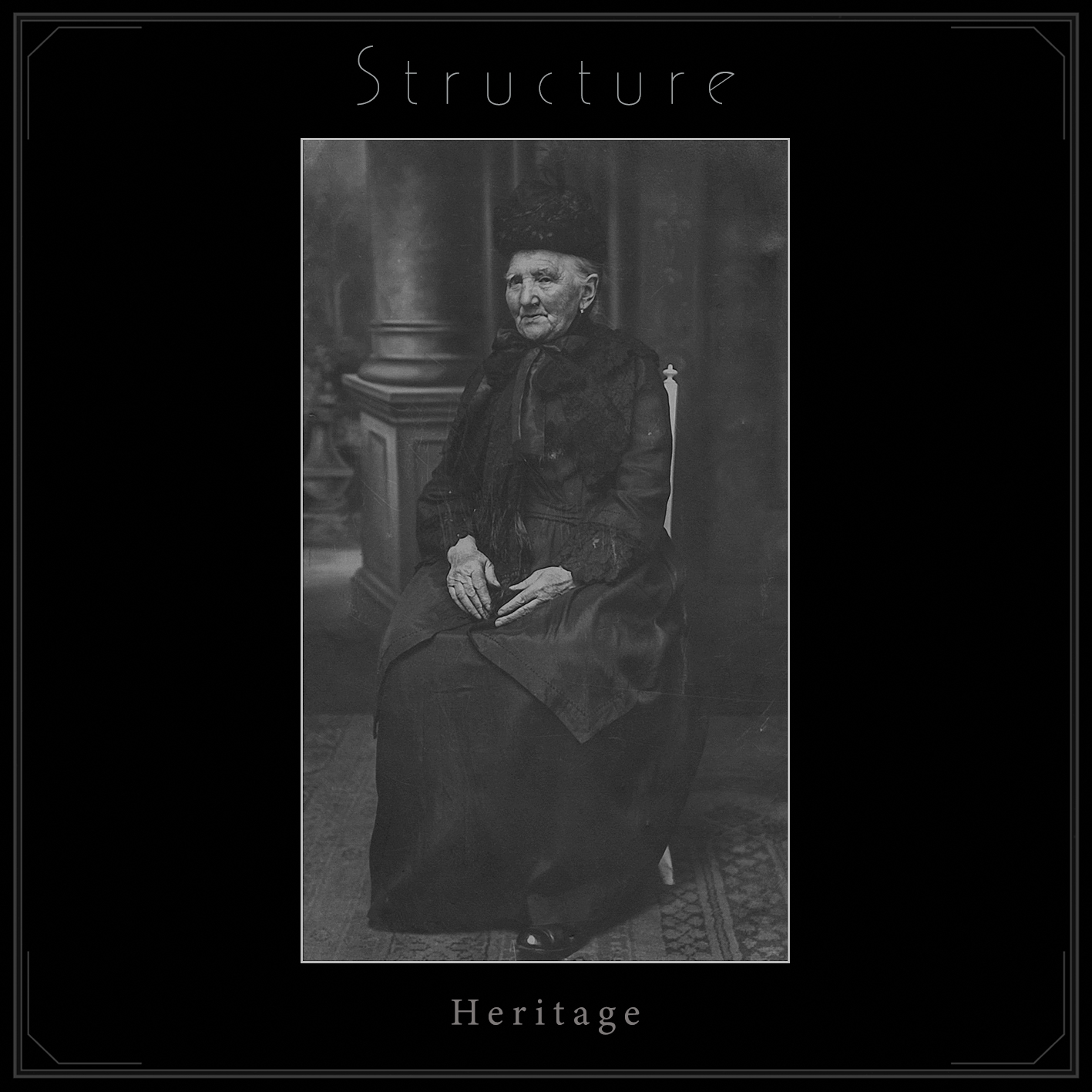

Memory is a complex thing. We try to remember as much as we can and learn as much as we can in order to create, and preserve, some semblance of a legacy. It’s why we keep mementos, why we take photos, why we bother to write things down and date them – we want to remember, knowing full well that those items will be the only things that could potentially outlive us. This is something that Structure aims to explore on their newest full-length, Heritage, an album that shows that the strongest memories are the ones with the most emotional impact. Also, for those keeping count: this is the third album to emotionally grip me within the span of a month. Perhaps I am not fully out from the confines of winter just yet.
Heritage is rooted in abyssal melancholia. It’s layered in dark, sonic hues that further this melancholia into haunting dread that permeates throughout the entire album. It also doesn’t help that the atmosphere feels funerary, as if you are slowly walking behind a procession towards the cemetery, the mood tense yet filled with anticipation. It’s odd to describe an album as “filled with anticipation,” but Heritage pulls the listener into its melancholia, keeping them tethered with the idea that something is coming. First track “Will I Deserve It” is easily the darkest song on the record, a heavy weight that threatens to sink you into its gray sea. It offers no reprieve from its dense nature, a song stricken with grief that promises to hurt, even when the music “lightens,” giving us the more familiar trappings of melodic death-doom. This is Structure’s cue that a certain brightness, however small, is coming, easing its dread and grief momentarily before transitioning on to the rest of the album.
However, this hope for brightness doesn’t mean that Heritage isn’t crushing. I have already mentioned that the music is dense, having this highly oppressive atmosphere that sinks into your bones. Structure doesn’t shy away from layering that heaviness throughout its runtime, making music that sounds as complex as it feels. It’s filled with nuance and texture, clearly a testament of Bram Bijlhout’s excellent instrumentation and composition. After all, Heritage makes the clear point that you will be mourning a lot in your life: your friends, your family, your own decisions. The atmosphere and mood here is incredibly reflective, making you sit in your own melancholia. Unlike the catharsis and vulnerability in Famine or the nostalgia in Transmissions, that feeling doesn’t go away; it lingers long after the music ends, sticking with you until you can no longer stomach it.
Despite its inherent dread, Heritage doesn’t shy away from having its bright moments either. Outside of the melody in “Will I Deserve It,” songs like “The Saddest Day of My Life” and the title track offer a sense of hope and reflection that comes amid grief. There’s this quiet throughline that runs throughout Heritage, allowing for moments to bask in its softness. These moments – sparse and few in between – remind us that we cannot sit in our melancholy forever. It may be a part of us, forever asking us to look at things in a certain way, but it’s not the only range of emotion we experience. Somewhere underneath it all, there’s hope and a sense of inner peace that we can strive for. Everything shall pass and there’s nothing we can do except let it pass us by.

It’s clear that Structure is no stranger to death-doom, as Bram Bijlhout was in Officium Triste for many years. Although some people will compare this to Officium Triste, Heritage is a meticulous record, one that wastes no room for its experimentation and atmosphere. Every sound, every composed note, speaks of the craft that Bijlhout has worked with over the years – the music is poignant and emotionally devastating. Heritage deserves to be added to the death-doom canon, another of the potential modern greats that allows this genre to continue flourishing.
— Hera
Heritage will be available April 25 on Ardua Music. For more information on Structure, visit their Facebook page.


Leave a Reply