
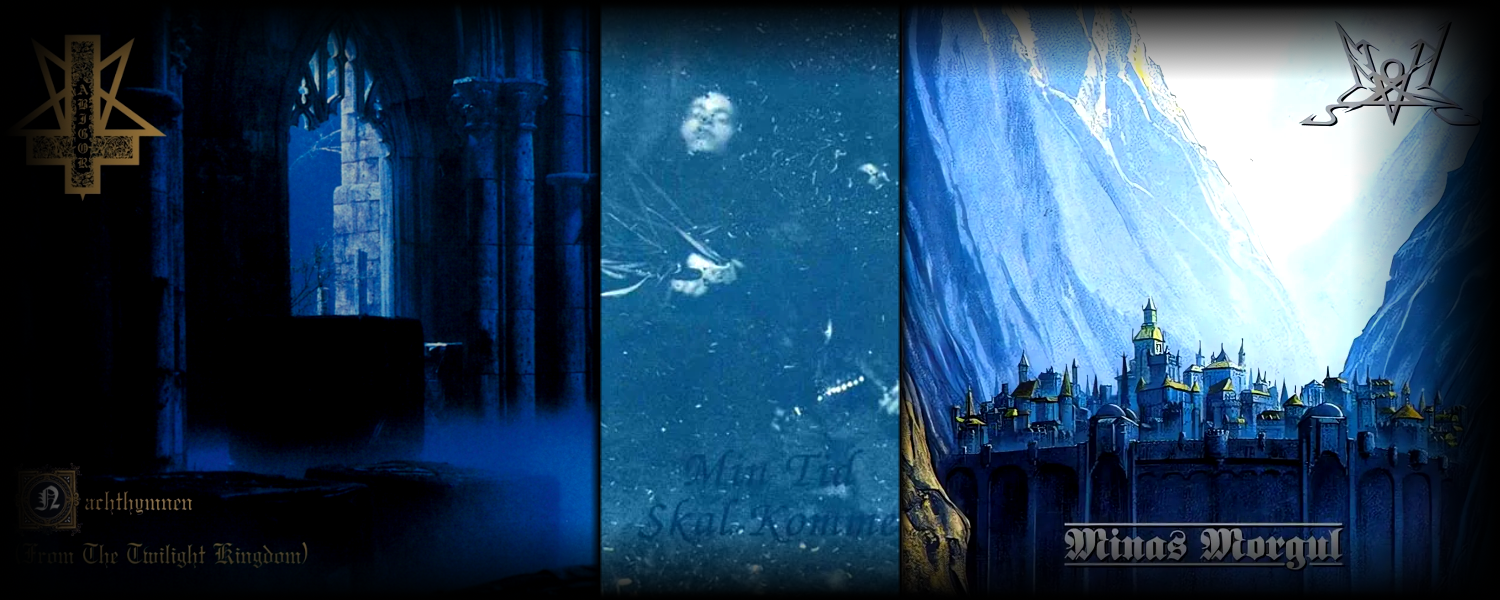
Had to take a break to finish the last full reviews of the year, but I have returned to take a look back at some more blackened classics that celebrated their 30th anniversary this year. Fitting for this time of year (I meant to get this out before Christmas, oops), this second part takes us to the alpine lands of Krampus with the first bands to be featured from Austria. Three blue covers, three distinct styles of black metal… and all three releases both an influence on and a sign of things to come within the genre to this very day.
—

Long before they decided to associate with a not-so-subtle NSBM label, Abigor were a group of young Austrians signed to good ol’ Napalm Records (which the band have both taken credit for becoming big and derided for apparently not putting out “real” music anymore) and putting out new music at a rapid pace. Nachthymnen (From the Twilight Kingdom) was the trio’s third full-length, released just five months after the dungeon synth-littered Orkblut – The Retaliation. Foreshadowing what was to be perfected the following year with Sacramentum’s Far Away from the Sun (or rather convergent evolution, as FAFTS had already been recorded by the time Nachthymnen was released), Abigor similarly played a form of black metal featuring multilayered guitars, polyphonic arrangements, and constant shifts in riff and tempo. This is apparent from opening track “Unleashed Axe-Age” alone as guitarists Peter Kubik and Thomas Tannenberger weave through a frenzy of numerous melodic leads, tremolo riffs, and descending lines all within the first few minutes. Adding to the chaos are the classic throat-shredding screams of Silenius (Abigor not being his only feature here today).
Getting picky with genre labels Nachthymnen is perhaps not fully deserving of the label of melodic or symphonic black metal, but certainly draws from both. Riffs build upon each other and resolve in a fashion only the most skilled of melodic black metal songwriters are capable of, and there’s more than a fair share of symphonic keyboard and dungeon synth-style percussion at play throughout the album. The primary flaw of the album is that there’s a bit too much thrown at the wall, and not all of it sticks. Intent for a gothic atmosphere aside, the clean vocals of guest Elisabeth Toriser tend to clash with the rest of the sound — working best on the slower “Dornen” — and the frequent need to throw in acoustic guitar interludes disrupts the pacing a bit. Nevertheless Abigor were a very young crew at the time, and with youth comes the fearlessness and lack of inhibition with such songwriting decisions.
In another parallel to Sacramentum and the recent passing of Nisse Karlén, guitarist Peter Kubik committed suicide last year. In their announcement the band openly referred to his legacy of “blood and soil” in addition to his musical output; coupled with Abigor being on a label owned by a member of perhaps the most notorious NSBM band of all time, it’s safe to call that more of an air raid siren than a dogwhistle (the founder of said band actually wrote lyrics for a song on Nachthymnen, though to my knowledge he was notorious for being a teenage murderer at the time as opposed to NS activities). A fact more common in black metal than most other genres is that — as unfortunate as it is — some great art is made by terrible people. I don’t bring this up as a smug gotcha, but a lot of the black metal crowd like to ignore such things… especially when it when it comes to bands with a pedigree of influence like Abigor. Regardless, on a purely musical level Nachthymnen (From the Twilight Kingdom) is a release worth remembering, and one that I imagine served as a blueprint for elite black metal songwriters in the decades to follow.
—

“I guess you guys aren’t ready for that yet… but your kids are gonna love it.” Although I can’t say for certain how much that quote pertains to Fleurety‘s debut full-length Min tid skal komme in terms of its reception at the time of release, what I can definitively say is that it’s absolutely wild that this album came out in 1995 (and from 18-year-olds, no doubt). Years before Enslaved, Borknagar, or Arcturus would become full-fledged progressive metal bands, this Norwegian duo were running circles around the rest of the Norwegian black metal scene at that time (aside from another act that will be featured in part three, perhaps) in terms of musical experimentation. Although it’s easy to say in 2025 that the works of Mayhem, Darkthrone, Emperor, etc. are bog standard for the genre today that’s because they sorta formed the genre as we know it. Musicians whose formative years were in the thick of the second wave in Norway such as Ivar Bjørnson have been candid about the fact that there wasn’t exactly a “scene” in terms of similar-sounding bands, but that the movement was more about experimentation and pushing boundaries than its often given credit for. So what exactly makes Min tid skal komme the “weird album” in this second look back 30 years?
Right from the first clean guitar chords and wistful leads of opener “Fragmenter av en fortid” it’s hard for me not to be reminded of more modern Cascadian and blackgaze acts. Fleurety do not drown their sound in reverb however, choosing instead to stick with the trebly sound typical of their more standard black metal peers of the time. Not yet formed are the grand crescendos typical of the previously mentioned styles, with Fleurety instead going full steam ahead with their tempo and style transformations (see the black metal into bouncy, syncopated prog of “En skikkelse i horisonten”). Dissonance may be all the rage in both black and death metal nowadays, yet Fleurety merely use it as a means to build tension and anxiety rather than a core facet of their identity (or as a crutch).
I own the 2019 Peaceville remaster so I’m not sure how much it differs from the original, but the production on Min tid skal komme is another big highlight. Crisp, snappy drums, eerie cleans from guest vocalist Marian Aas Hansen (that are much more appropriate for this album than similar vocals on Nachthymnen). Most important is the warm, lush session bass that features what is likely the first ever instance of slap bass on a black metal album (“Englers piler har ingen brodd”). A masterful work of avant-garde black metal from a pair of teens who were way ahead of the curve, and an album that is absolutely essential for any fan of prog metal both past and present.
—

Like Enslaved the year before, Summoning released their first two full-lengths within six months of each other. Whereas either Vikingligr veldi or Frost could easily be considered the best album of Enslaved’s early work depending on who you ask, Summoning had a considerable shift in sound (for the better) between their first and second full-lengths. Lugburz isn’t exactly a bad album, but the more traditional black metal it features was certainly not up to snuff with either Abigor or much of the most well-known Scandinavian bands at the time. With Minas Morgul the band would change that, releasing not only a legendary album in its own right but one that birthed an entirely new subgenre of black metal. Silenius’ work with Abigor gave him an in with Napalm Records, who released Lugburz in March 1995. The atmospheric, dungeon synth-meets-black metal of Minas Morgul had first appeared in raw form on a demo tape the previous year, but wouldn’t be unveiled to the world until the full album’s release in October ’95, following the departure of drummer Trifixion. With this album came the style later known as “epic black metal”.
As a teen searching for Tolkien-themed metal beyond Nightfall in Middle-Earth, Summoning was obviously the direction I was pointed in. “The Passing of the Grey Company” was the first song by the duo I ever heard, and what an introduction! Black metal is no stranger to being over the top — what with corpsepaint photoshoots in the forest, claw hand poses, and all manner of vocal weirdness — but that track was likely the first time I heard anything like medieval-sounding keyboards infused with the genre. Was it a bit goofy? Sure. But does it meld perfectly with the genre and themes? Absolutely. As anyone not irony-poisoned would tell you, once you can embrace the cheese a grand realm of art opens itself up to you. I’ve had a hard time getting into dungeon synth proper, but when it’s combined with black metal — whether as interludes or as a real fusion such as what Summoning pioneered — it’s sublime. Even when the duo abandon most of the metal elements such as on “Dagor Bragollach” or “The Legend of the Master-Ring” they create a grand, epic sound despite so little at their apparent disposal.
While I am a firm believer that epic black metal was perfected with Caladan Brood’s opus Echoes of Battle, it had to start somewhere. Minas Morgul is long, the guitar lines and song structures repetitive, the synths and programmed drums not exactly top-notch quality, and the alternating rasps and howls of Protector and Silenius a bit much (for some)… but this is all part of the Summoning charm and atmosphere. Cribbing the lyrics directly from Tolkien’s legendarium would be pretty gauche in 2025, but was an inspired decision 30 years ago. Just as the sights, sounds, and Howard Shore’s legendary score for The Lord of the Rings trilogy will forever serve as the template for Middle-Earth in the eyes of many, so too is the sound of Summoning intrinsically tied to this world when it comes to the realm of black metal. There are countless acolytes who follow the paths of Summoning’s epic black metal sound — with few managing to improve what first started here — yet the road from Minas Morgul goes ever ever on.
—
Two parts down, one to go. Part three will feature perhaps the most important and influential of the “weird” Norwegian black metal albums of 1995, along with a long-overdue return to southern Europe and my thoughts on an oft-described masterpiece (that I don’t quite see that way). Stay frosty, and I hope to finish this off soon.
— Colin
Leave a Reply