
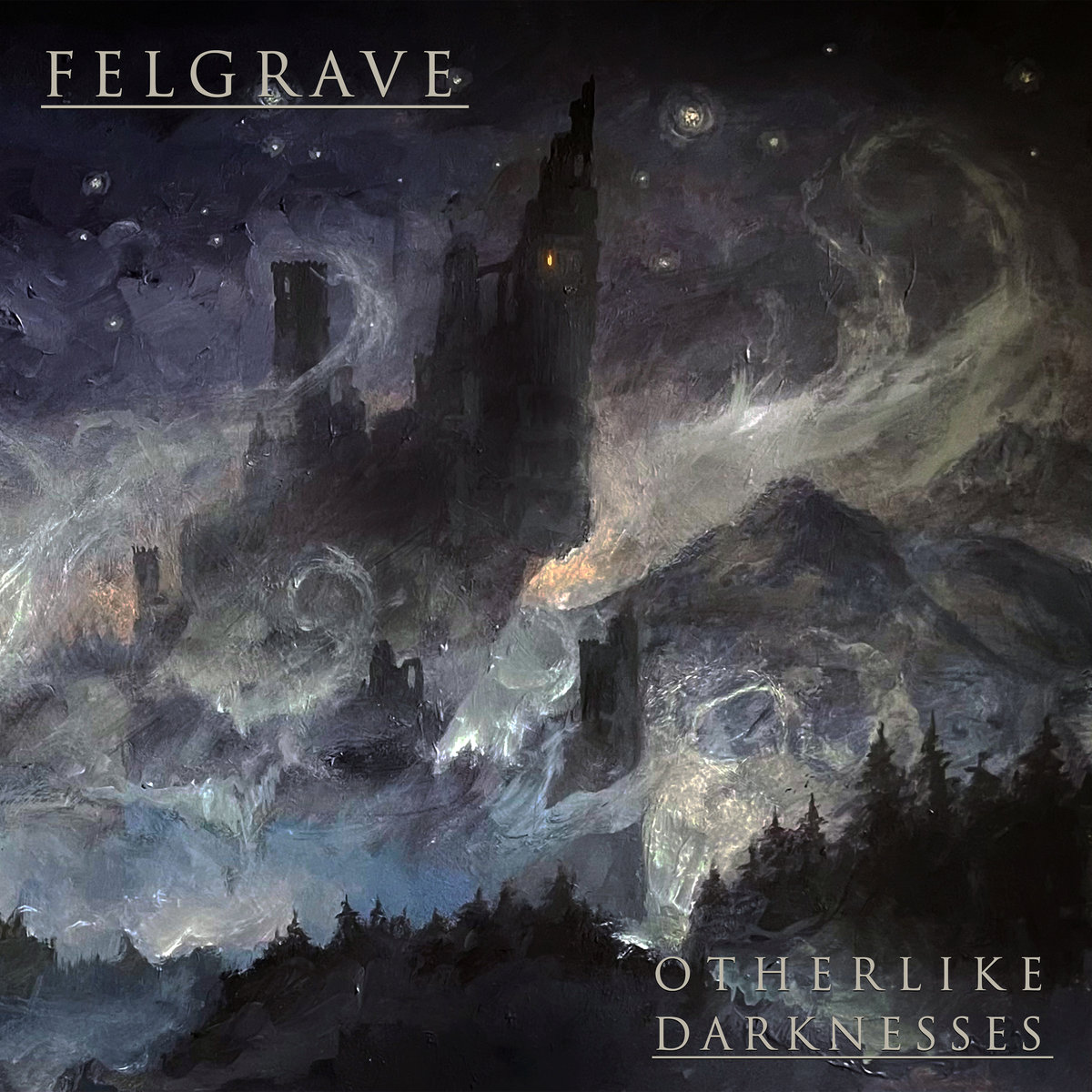

Heavy metal has come a long way in the ~50 years since its inception. Countless subgenres, scenes, and general trends have come and gone, with more surely waiting in the wings amongst the endless well of talent in the world. I love a good throwback album, or one that at least builds on some type of classic sound; some of my favorite new bands in the past decade fall into this category. Yet every so often an album comes along that sounds so fresh, new, and different — even if the basic elements are familiar on the surface — that it almost defies description. Such is the case with Otherlike Darknesses, the sophomore album from Norwegian solo act Felgrave. These three monolithic tracks are a maelstrom of black/death/doom that completely eschew typical songwriting notions even on the furthest fringes of these genres, yet threads the needle by not falling into an inscrutable realm as can happen with the most daring progressive/avant-garde bands. M. L. Jupe’s symphony of extreme metal chaos is truly something to behold.
A Waning Light (the 2020 debut from Felgrave) is a very solid album that feels like a death doom-ier Tchornobog or The Ruins of Beverast, shedding the ritualistic rhythms that have characterized the latter’s more recent material while retaining the eerie clean chords floating above the heavy, riff-filled murk. While progressive in songwriting and often polyphonic in riff construction, it wasn’t particularly “out there” (at the very least, it was still rooted in discernable riffs). The evolution in sound from the debut to Otherlike Darknesses is so stark that I’m surprised there wasn’t one, or rather two albums released in between; this is clearly a testament to Felgrave mastermind M. L. Jupe’s confidence in songwriting in the five years since the debut. Consisting of two 18-minute epics separated by a mere 12-minute track, these songs are ultra-linear exercises in concentration and picking out the fine details (difficult as it may be in today’s world of nonexistent attention spans). I’ve been racking my brain to find musical comparisons for this album and have largely come up short, so my mind went to cinema. The experience of listening to Otherlike Darknesses reminds me of the first time I saw Mad Max: Fury Road in theaters almost 10 years ago — that realization around 30 minutes in that the entire movie might just be an extended chase sequence, mostly ditching the three act structure typical of a film. That’s what opening track “Winds Batter My Keep” is like; sure, there’s a motif in the form of a recurring jagged chord, but there’s no semblance of distinct riffs that clearly delineate one section from the next (the auditory version of a movie plot in this analogy, perhaps). About six minutes into the song comes the realization that there wasn’t really an intro, that this will continue in stream of consciousness fashion for the entirety of its runtime. The polyphonic nature of the arrangements is absolutely essential in aiding and abetting this song structure; we can only focus on so much at once, and while trying to parse one specific riff or melody the song is already transmuting into the next one.
This may sound like a hell of a lot to take in (and trust me, it is), but as someone who hasn’t drooled over weedly tech death in years nor is the biggest adherent to the “dissodeath” scene, Otherlike Darknesses is a welcome palate cleanser. This album is absolutely chaotic, infernal, and oftentimes dissonant, but not in the same sense that has been ascribed to current heavyweights such as Ulcerate, Imperial Triumphant, and Artificial Brain. It’s hard for me not to contrast Otherlike Darknesses with Ingurgitating Oblivion’s Ontology of Nought last year; that album is clearly a death metal take on avant-garde jazz that might become a modern classic for some, but has nowhere near the “accessibility” of Felgrave. If you were to peel back the layers at any point on this album and make them more repetitive, I have no doubt it would feel a lot more like standard black or death metal — it’s all about the composition.
A vast majority of this album is a manic black/death frenzy, but there’s moments of clean guitars and vocals used to great effect, turning “Winds Batter My Keep” increasingly anxious to the point of screaming for release — this comes in the form of a reversion to some of the opening riffs (as if that really lessens the despair). This song also features some blackened walls of chords that preempt the vocal melody itself, just one of the many realizations that makes Otherlike Darknesses more enjoyable with each listen. Second track “Pale Flowers Under an Empty Sky” is the most consistently fast and technical; at multiple points one guitar channel is a chunky death metal riff while the other is its chord-heavy black metal counterpart, a feat that puts to shame any black/death band doing the simpler “death metal section followed by a black metal section” style of songcraft. Closer “Otherlike Darknesses” continues Felgrave’s ability to constantly surprise; there’s a triumphant buildup that would feel like the finale with any other band, but then you glance at the runtime and there’s still 13 minutes to go. The clean guitar/vocals section at around the 11-minute mark is perhaps the only time Otherlike Darknesses feels like an existing act, highly reminiscent of some of the calmer sections on Gorguts’ Colored Sands (unsurprisingly, the similarities soon disappear in a wave of blackened chords).
There’s so much packed into Otherlike Darknesses that I haven’t even mentioned Jupe’s bass performance! Melodic and highly prominent, the bass lines bind all the disparate sections together, latching on to either the drums or guitars as needed (or perhaps, these instruments follow the bass). The bass is probably the unsung hero of the album, with little fills and licks galore when not locking in with the drums. Session drummer Robin Stone (Evilyn, Norse) similarly gives it all in his performance, effortlessly guiding through a dizzying variety of time signatures, tempos, and moods with deftness. The handful of sections in which he accelerates the tempo in conjunction with the swell of the guitars are some of the most exciting on the album; and as the genre naturally requires, his blast beats and frequent fills are a fantastic addition to the overall chaos. Keyboards are sparingly used to enhance the gloomy atmosphere, yet never take center stage. This entire cacophony of sounds could easily become a muddied mess, but thanks to the in-house mixing of Jupe and mastering by Brendan Sloan (Convulsing) the line between over and underproduced is nonexistent — each ingredient in the sound is as exactly clean, rough, or loud as it needs to be.

Otherlike Darknesses is perhaps the music that would be made if you went back to the early 70s, snatched up some legendary prog rock musicians, sent them through the Fly of Despair for 50 years, and put them in a studio with metal instrumentation. It is absolutely dripping in dark, chaotic, oppressive atmosphere, yet is unlike any slime-coated death doom or infernal black metal that I’ve ever heard, at least. Thanks to the utterly enthralling nature of the songwriting throughout, the end of Otherlike Darknesses comes well before you realize it (and is rather abrupt). Yet as manic and anxious an atmosphere as this album often generates, once it concludes I just want to start it over and experience this beautiful cacophony all over again… something I hope to do for a long time to come, at least until the next challenger in such forward-thinking extreme metal dares to come forward.
— Colin
Otherlike Darknesses will be available April 25 on Transcending Obscurity Records. For more information on Felgrave, check out their Facebook page.


Leave a Reply to Best of (the first half) 2025: Colin's Mid-Year RecapCancel reply