
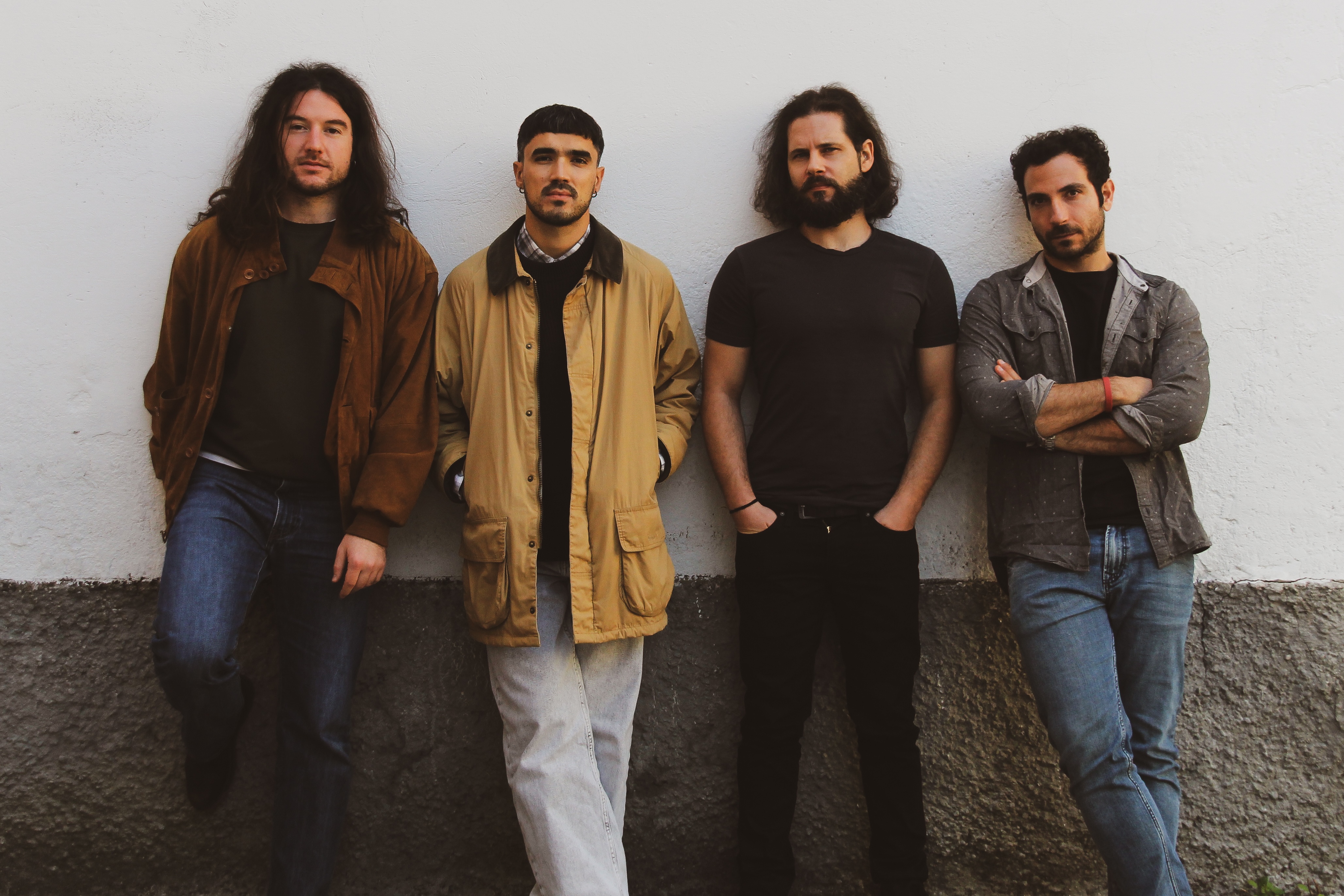
We’re going all the way back to early March with this latest Profile, but I assure you this is one that is absolutely worth revisiting at this point in the year. Or discovering for the first time if it slipped by you. Italian stoner rock crew Desert Collider released Generation Ship: Endless Drift Through Infinity through Small Stone Recordings way back when, and it is right up there with my favorite desert/stoner/psych albums of the entire year. And, if you’ve been paying attention around here, it keeps Small Stone Recording’s impressive run very much intact. Just one killer release after another from them. As for Generation Ship, Desert Collider’s debut is indeed filled with all of those heavy punching rhythms we would want from this genre, but what stands out for me is their effective use of atmosphere and depth. It expands outward without feeling forced or lost, which, in turn and in the opposite direction, keeps any moments from feeling repetitive or overdone. It’s simply a great album, in sound and structure. So at this point I’ll turn it over to their responses to our questions so you can familiarize a bit further. Enjoy!
—

How and when did you first get into playing music, or metal more specifically, and how did your band get its start? Any pushback from family/those close to you?
Like many musicians, we all started out as angry teenagers using music as a way to untangle and interpret the world around us. Different paths, same underlying need. Over time, we learned to extract the best elements from our environments and channel them into something constructive.
The first building blocks of Desert Collider took shape around 2022, when I met Manuel Colucci while we were both working at a research institution. It quickly became clear that we shared a common musical language. Metal in its various forms has always been a foundation for us: I had previously released albums in the Italian pagan metal scene, while Manuel played in an industrial metal project.
From there, we began building the band step by step, with stoner rock as our core direction. Federico Gianfanti and Andrea joined at a later stage, and it was when the four of us came together that the project found its name and a clear vision. We started by jamming on bands like Kyuss and Fu Manchu, gradually shaping a more defined identity of our own. Entering the studio for “Generation Ship:…” was key in defining our final sound.
As for pushback…none, fortunately 🙂 We’ve always had strong support from the people around us. That said, we do try to maintain a healthy balance, making sure our commitment to music coexists well with the rest of our lives and relationships.
How would you describe your band and what you play to someone who is completely in the dark?
Desert Collider is, at its core, a stoner rock band. But that’s our foundation, from which we treat it as fertile ground rather than a constraint.
We take what resonates with us, across genres, moods, and influences, and integrate it into that base. The result is something rooted, but not rigid, giving us a wide range of experimentation and possibilities.
Is there anything about your latest album or about your band that no one will find in any interview or review that you care to divulge?
A lot of the conceptual backbone comes from literature rather than music. We’re not just writing songs… we’re slowly building a narrative ecosystem that pulls from authors, philosophical ideas, and abstract imagery.
Some of these references are intentionally buried. They’re not meant to be immediately decoded, but they shape the atmosphere and direction more than people might expect.
Any funny stories from playing shows / tours / festivals, etc?
At this stage, we are doing our best to reduce chaos and improve controlled unpredictability 🙂
So we are afraid we have to give you a boring answer about this.
What do you see as some of the great things happening in and around the metal scene (yours or just in general) and what are some of the worst things happening right now?
This is a tricky one. We tend to have a slightly nostalgic perspective, so take it with that in mind. We’re living in an era of accelerated consumption. Social media is incredibly powerful, but it also forces artists into constant visibility and output, which doesn’t always align with the natural pace of creating meaningful music or art.
What we appreciate most are bands with a clear identity, where you can hear (for those willing to listen) both the attitude and the lineage. For example, seeing bands like Blood Incantation gain traction is great. That kind of sound requires depth and understanding.
On the other hand, we are less convinced by some trends in extreme metal that seem to move away from riff-driven structures in favour of constant breakdowns or purely groove-based approaches to the point of redundancy. It sometimes feels like the core language of the genre is being diluted.
That said, there are always counterexamples. We shared stage with a very young sludge band once (Mr. Hygh, from Italy), and it was reassuring to see they had a deep knowledge of the roots. So, the foundation is still there.
As for stoner rock, it’s a different story. We think it remains deeply connected to a broader musical tradition. There’s a continuity there that we really value. In Italy, there are people that are giving blood and soul to keep the scene intact by keeping the bands in contact and organizing great festivals. We own them so much.
Most folks have passions for a cause or causes that are close to them. What, if any, are some of the most important issues (social/political/humorous/etc.) for you / your band and how do you insert those issues into your music?
We don’t approach music as a vehicle for explicit political messaging. It’s not about avoiding positions, but about focus. Politics isn’t central to our artistic vision.
What we do integrate is a strong influence from literature and conceptual storytelling. That’s where our thematic depth comes from. Going forward, we’re also planning to expand more deliberately into structured narratives across releases.
Do you have day jobs or hobbies you want to share?
We all work in the biology/biotechnology sector. Outside of music:
– I am into ink drawing, reading, cinema and motorcycle riding.
– Andrea is deeply into photography, especially analog, drawings and hiking.
– Manuel as well is a lot into sport and hiking.
– Federico (Gianfanti) is a lot into reading and cinema.
What advice do you have for music critics and outlets out there? How can we all better serve the genre in the eyes of a hard-working musician?
Honestly, what you’re already doing, giving visibility to bands, is essential.
If anything, the most valuable contribution is depth: taking the time to understand why a band sounds the way it does, not just what it sounds like.
Any specific long term goal(s) in mind?
To keep evolving, musically and conceptually. We don’t want to repeat ourselves. The goal is to continuously challenge our own potentials and explore new cultural and sonic territories without losing coherence.
When you’re not obsessing over your own material, what are some of your favorite albums to listen to currently?
Our listening habits are quite varied, but there’s a clear common thread: we tend to gravitate toward records with strong identity, atmosphere, and a sense of complete artistic vision.
Manuel moves between classic prog, hard rock, and more technically inclined music. Albums like “A Farewell to Kings” by Rush and “Atom Heart Mother” by Pink Floyd sit alongside heavier milestones such as “Kill ’Em All” by Metallica and “Piece of Mind” by Iron Maiden. He also leans into more modern and layered songwriting with Steven Wilson’s “The Raven That Refused to Sing”, and even beyond rock entirely with Marcus Miller’s “Afrodeezia”.
Andrea’s taste is more directly rooted in heavy music and its experimental edges. He often revisits “Vol. 4” by Black Sabbath, Led Zeppelin’s “House of the Holy” and “Rust in Peace” by Megadeth but also appreciates more unconventional contemporary records like King Gizzard & the Lizard Wizard’s “Infest the Rats’ Nest.”
Federico (Gianfanti) is well rooted in the heavy desert sound, with records like Kyuss’ “Welcome to Sky Valley”, Nebula’s “Heavy Psych”, Queens of the Stone Age’s “Songs for the Deaf”, Truckfighters’ “Gravity X”, and Mark Lanegan’s “I’ll Take Care of You” are recurring references.
About me, the reference points are often towards atmospheric and expansive scopes. “Bergtatt” by Ulver has been a constant landmark in how I think about mood and contrast. On the more instrumental and immersive side, Mike Oldfield’s “Ommadawn” is another essential reference, almost architectural in how it builds its narrative through sound rather than lyrics. But still for me one of the perfect records remains “Déjà Vu” by Crosby, Stills, Nash & Young… a masterpiece in songwriting & balance. I also draw from more experimental and industrial-
leaning territory, including Einstürzende Neubauten, alongside the contemporary heavy psych and doom spectrum of Messa and Ponte del Diavolo.
What is the near future outlook for you or your band? Any specific events on the horizon that the masses should be aware of?
We’re focused on writing and refining new material, while steadily increasing our live presence. There are a few developments in the pipeline, but we prefer to announce things once they’re fully concrete. For live shows, we are focused on playing at music festivals in the genre and we are going to play some other shows in the near future, but the studio is getting closer and closer :).
Summarize your band in one word.
Evolving.
—
Many thanks to Desert Collider for the time!
Generation Ship: Endless Drift Through Infinity is out now through Small Stone Recordings. For more on Desert Collider, follow them on Instagram.
Leave a Reply