
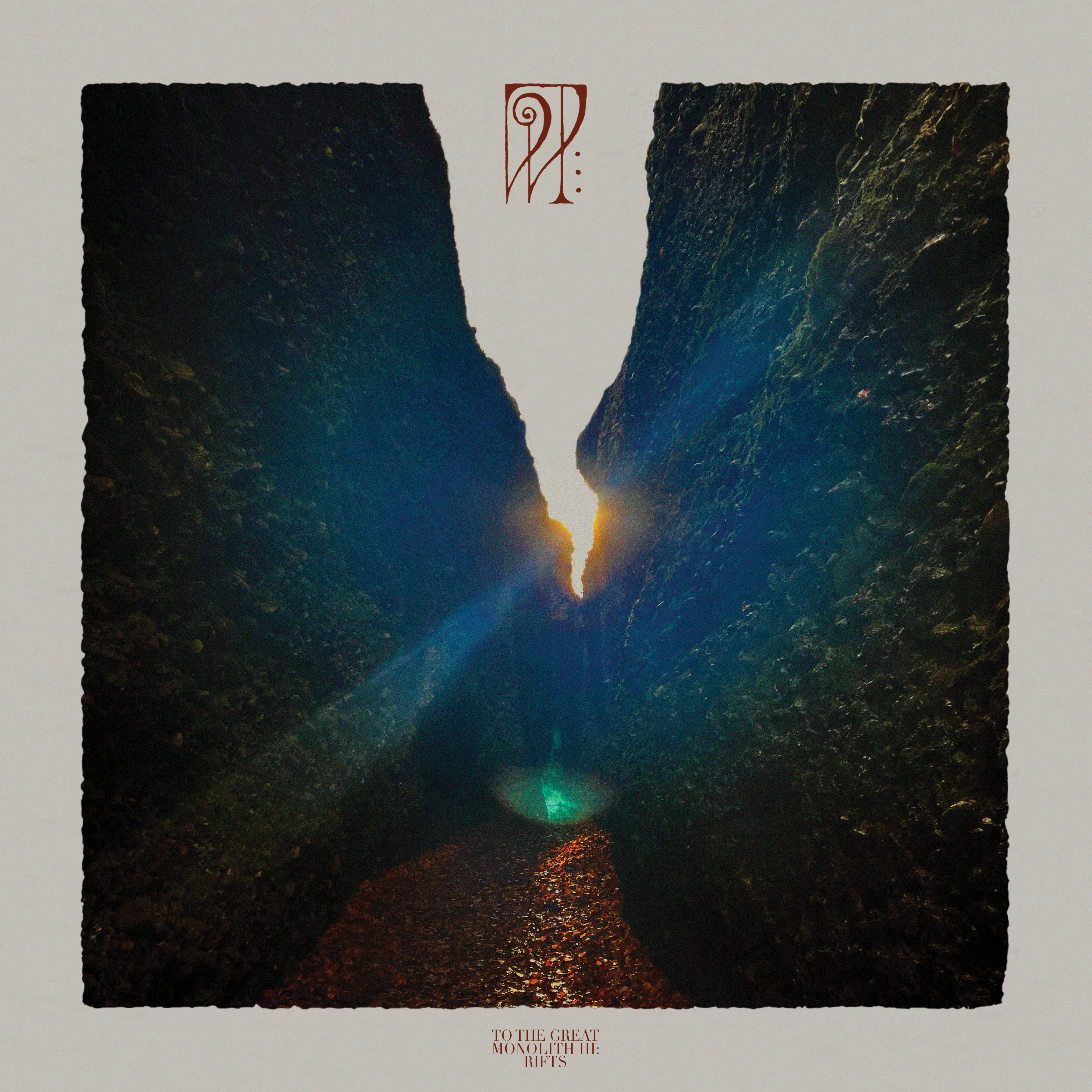
Outside of virtuosic prog or the glassy-eyed world of stoner/doom, perhaps, metal has never really been the friendliest genre to improvisation. But as the exemplary minds behind Death. Void. Terror. demonstrate in their third monolithic manifest, it is very possible to craft metal that is both partially improvised and intriguing to listen to. To the Great Monolith III: Rifts is yet another offering from the Swiss collective Jünger Tumilon, best known for Ungfell, Arkhaaik, and many other great projects. While previous efforts To the Great Monolith and its successor II were fully improvised exercises in cavernous noise and black ambience atop a bedrock of doomy black metal, Rifts sees the proverbial beast that is DVT exiting the cave and entering a new apocalyptic landscape, this time partially “on-rails”… the end result is superb.
In contrast to the inagural DVT releases, III has specific elements “consciously composed” — bass and additional sounds — while the guitars, drums, and vocals are all improvised. On paper, one could imagine how easily this could end up a half-baked mess; as if a (fully-baked) jam band merely decided to start screaming, play metal riffs, and call it a day. But as the Jünger Tumilon crew prove time and time again, their own musical instincts and prowess prove the day… Rifts not only serves as a compelling experience on its own, but is a fine addition to the Tumilon pantheon. Despite such an ostentatious descriptor as “experimental black metal” which could conjure such wide-ranging names as Arcturus, Krallice, Gnaw Their Tongues, and more, that does DVT a disservice. The manner by which each of the five tracks that comprise Rifts grow and evolve in a very natural manner draws comparisons to the world of post-metal than anything else… though perhaps by convergent evolution when compared to Neurosis and the like. If we take that genre’s description at face value, DVT have certainly arrived at a place where metal instrumentation is used for textural and atmospheric reasons rather than just aggression and riffs.
The creations on Rifts tend to move along at a plodding pace that very much recalls Arkhaaik’s incredible Uihtis last year; while that release was temporal in its evocations and (intentional or not) focused on creating the most crushing riffs possible, DVT instead find themselves in more patient and ethereal waters. Opener and longest track “I. (– — – — -) Gözdyrey” sees a gradual crescendo build up over its 12-minute runtime, anchored by the bass and driven by not just the drums but the kaleidoscopic vocals. Deep roars, shouts, ritualistic chants, strained screams, just about every type of vocal delivery you might’ve heard on another Jünger Tumilon album (and more) finds its way onto Rifts. “II. (- — – –) Ids Elrekis Frakhetir” puts King Diamond falsettos atop eerie noise, the whimsical conclusion of “IV. ( – – –) Flukhetor” sounds like it could’ve been taken from a Danny Elfman soundtrack… and it’s all awesome.
Aside from the lack of traditional metal riff structure, what makes DVT all the more interesting is how the guitars ultimately end up being used. While not as buried in noise as on To the Great Monolith II, for instance, there’s still a distance between the guitars and the listener… as if they’re just behind a veil. As I’ve mentioned before Ophanim’s Tämpelskläng is a favorite of mine, and to my great pleasure the organ-like guitar sound that characterizes that masterpiece notably reappears on “II” and “IV”; helping to usher in the closing groove of the former and invoking cathedral-like grandiosity on the latter. Like some of the riffage reminiscent of Arkhaaik or Arrows (debuted last year), the additional sounds that fill out the psychedelic landscape of Rifts similarly remind of previous Jünger Tumilon efforts in one way or another. It’s as if going through a dreamscape built from bits and pieces of all that has come before… without just copying and pasting, as if that needs to be said.

This observation may just get at the heart of what To the Great Monolith III: Rifts ultimately accomplishes. The so-called “rift” is not just what Death. Void. Terror. have inflicted upon their previously established methods of composition (or lack thereof) by introducing consciousness into the process. But the rift also appears to have opened up and swallowed the entirety of the Jünger Tumilon world and spat it back out through the opposing unconscious, instinctual aspects as well.
In a world where so much artistic appreciation gets hand-waved away or dismissed through layers upon layers of irony and unwillingness to truly engage with the creative sparks within, I am ever grateful for such dedicated practitioners as the Jünger Tumilon collective. How many of their peers would dare to involve this level of improvisation on an album? And of those, how many would end up coming up with an album this good in the process? The slow-moving beast that is Death. Void. Terror. has taken a long while to reach Rifts, yet the path from dark chasms to the darkly beautiful, prismatic devastation that is To the Great Monolith III proves to be, as true art should, entirely worthwhile.
— Colin
To the Great Monolith III: Rifts will be available September 25 through Sentient Ruin Laboratories. For more information on Death. Void. Terror., check out the Jünger Tumilon Instagram page.


Leave a Reply